How to Write a Music Video Treatment
The first treatment I submitted for a paid job was four pages of dense text, no images, and a colour reference that was "kind of like early Wong Kar-wai but warmer." The director read it in 47 seconds — I know because I was sitting across from him — and said "I don't see it." I'd spent nine hours writing something nobody could picture.
The second treatment I wrote for the same artist was 6 pages, two-thirds images, one paragraph of concept text, and a single line explaining the visual approach. It got greenlit in the same meeting.
Quick answer: a music video treatment is a pitch document that communicates your creative vision before production — concept, visual style, mood, and scene direction. It works as both a pitch to the artist and a production roadmap for the crew. The one rule that doesn't change: if the person reading it can't picture the video, you've failed.
What a treatment actually is — and what it isn't
A treatment is not a script. It doesn't describe every shot or list every lens you plan to use.
It's a document — usually a PDF — that communicates the mood, concept, and visual approach of a video well enough that an artist, label, or video commissioner can decide whether your vision matches what they want. Once the project is greenlit, the same document becomes the creative reference point for every department on set.
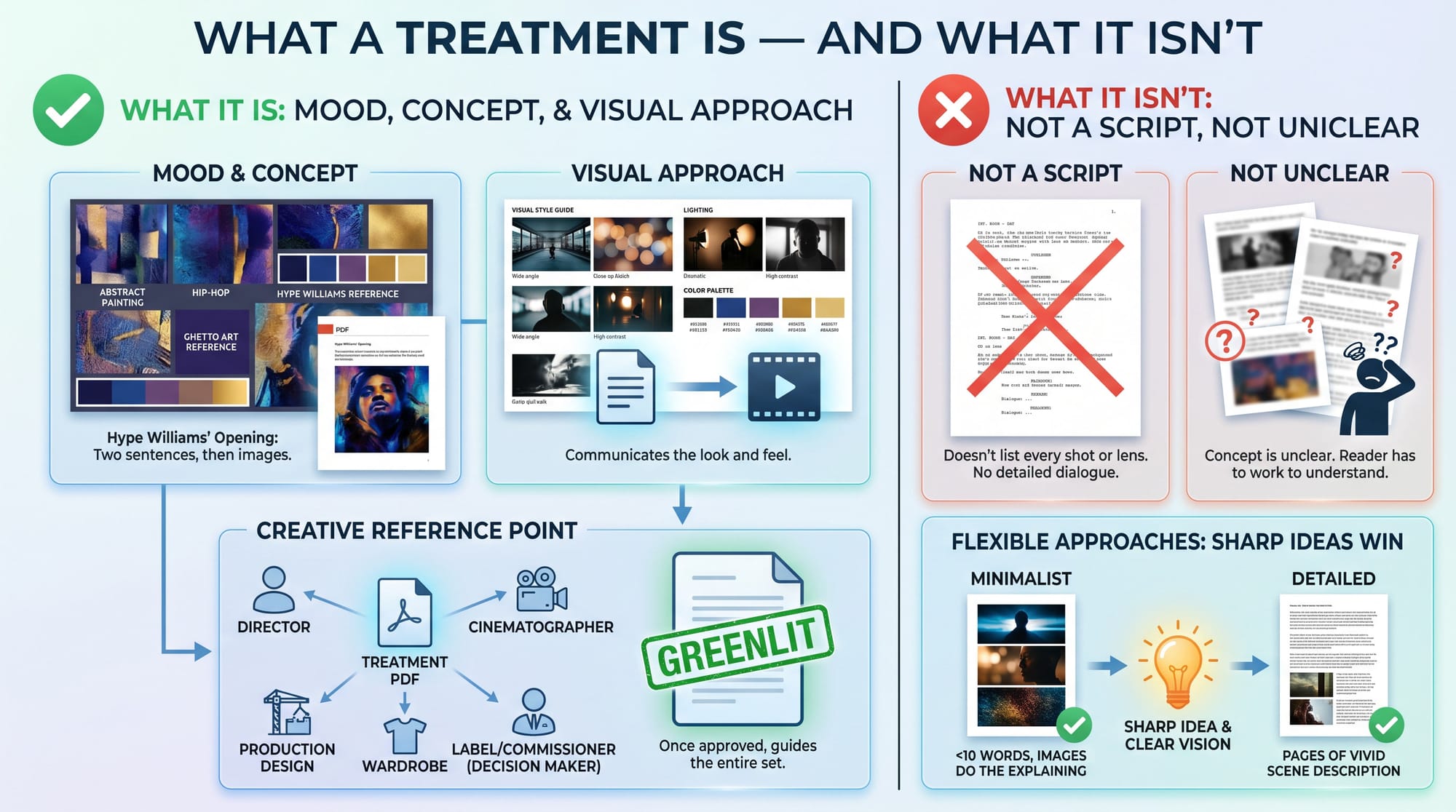
Hype Williams, directing "If I Ruled the World" for Nas and Lauryn Hill, opened his treatment with two sentences describing the video as an abstract painting, a different look for hip-hop derived from ghetto art. That's the concept. The rest of the treatment showed what it looked like. Some directors win treatments with fewer than 10 words in the entire document, paired with images that do all the explaining. Others write pages of vivid scene description. Both approaches work when the idea is sharp. What doesn't work is a treatment where the concept is unclear and the reader has to work to understand what the video will look and feel like.
Listen to the song before you write anything
This sounds obvious. It isn't followed as often as it should be.
A treatment that doesn't reflect the actual song — its tempo, structure, emotional arc — immediately signals to the artist that you haven't done the work. The verse feels completely different from the chorus in most songs. If your treatment treats the video as a static mood piece when the song has a drop that changes everything, the label notices.
Before writing a single word, I listen to a track a minimum of 23 times across different contexts — in headphones, through speakers, while doing something else, then sitting still with it. By listen 12 or so I usually have one image or scene that keeps appearing in my head when a specific moment in the song hits. That's where the treatment starts — not from a concept I decide to apply to the song, but from something the song already suggests.
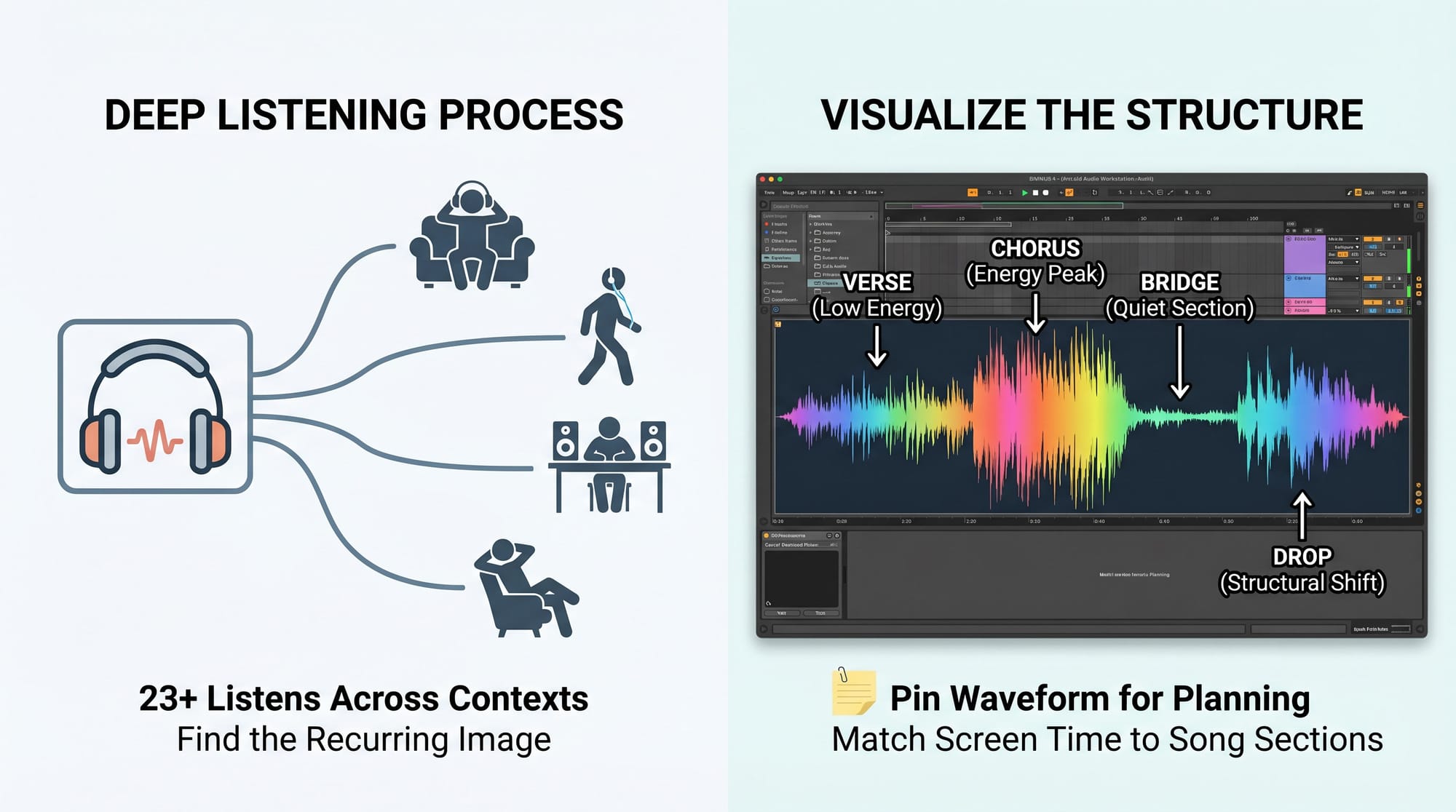
Also useful: take a screenshot of the song's waveform in your DAW or on SoundCloud. Pin it while you're planning. It shows visually where the energy peaks, where quiet sections are, how much screen time each section requires. It stops you planning a two-minute performance section for a 30-second verse. I started doing this after losing 90 minutes on a concept that turned out to require three times more footage than the song had room for.
The sections a treatment needs
Most successful treatments cover the same ground regardless of length or visual style. The order and weight you give each section depends on the project.
The cover page does more work than most people give it credit for. Song title, artist name, your name — yes — but the image you choose sets the first impression before anything is read. If the cover doesn't create a mood, the rest of the treatment has to fight harder to establish one.
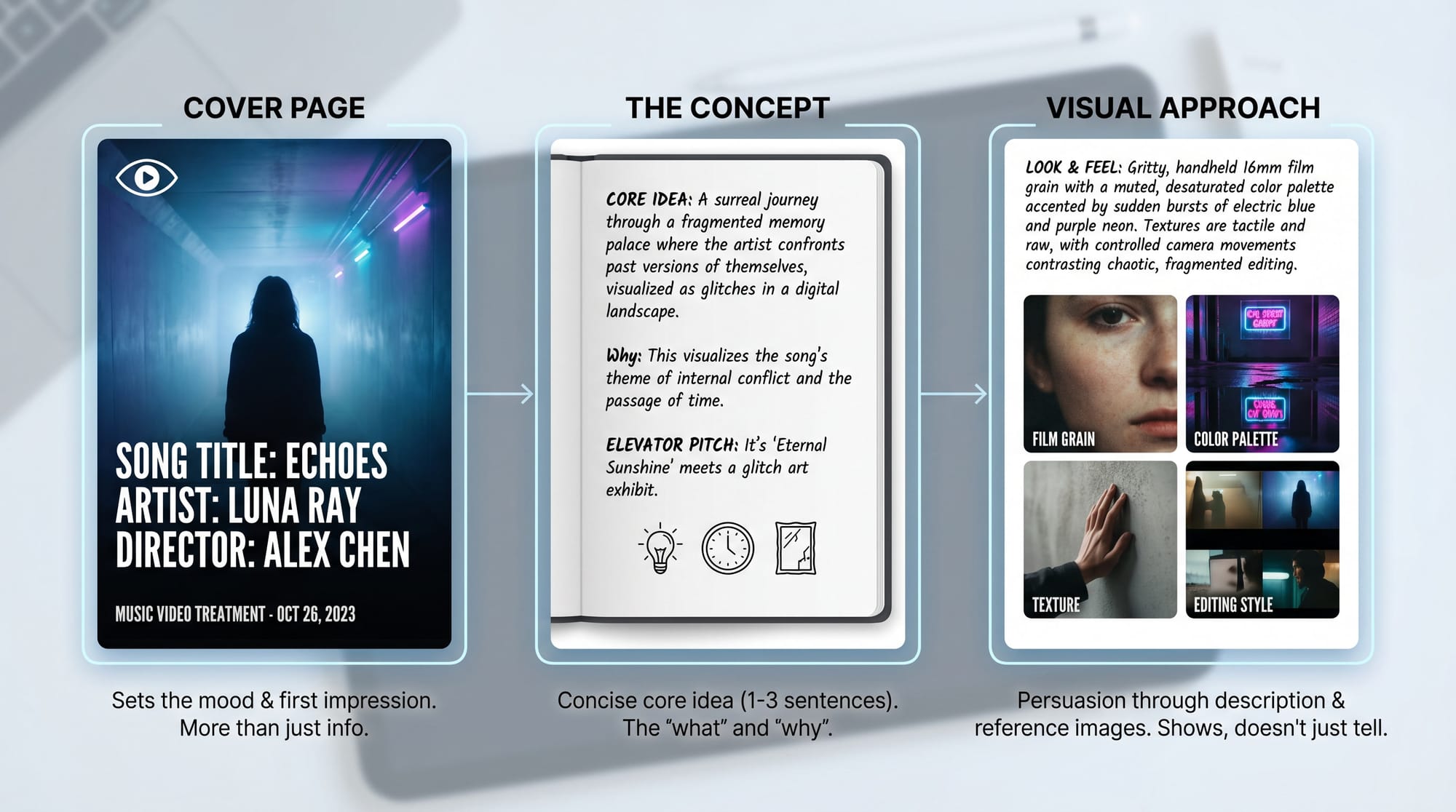
The concept, usually one to three sentences, describes the core idea — not the plot, the idea. What is this video actually about, and why does this approach serve this song? It's what someone would repeat in a five-second conversation to the artist's manager. If you can't write it in three sentences, the concept isn't clear enough yet.
The visual approach section is where most of the persuasion happens. A paragraph describing the look — colour palette, texture, shooting style, whether it's handheld or locked-off, whether it feels raw or controlled — paired with reference images that show rather than explain. I spent six hours on this section alone for a treatment last year that ran to only eight pages total. That time was worth it: the images were doing the work of four additional pages of text.
For narrative or concept videos, a scene breakdown covers what happens and when — broad strokes, not shot-by-shot. For performance-only videos, a description of the visual motifs and performance setups. Emil Nava's treatment for "River" by Eminem, which StudioBinder has broken down in detail, shows what a thoroughly written scene description looks like at the top level of the industry — specific, visual, in present tense, with clear purpose stated for every element.
A director's note is optional but worth including when pitching to labels. A personal paragraph about why you connected with this song and what you're trying to say. Labels want to know the person behind the concept, not just the concept.
How long it should be
Length follows the project and who you're pitching, not a universal rule.
For a performance video or a pitch to an independent artist: 4–6 pages, mostly visual references, one tight concept paragraph, brief scene direction. I've won jobs with 5 pages. I've also lost jobs with 14 pages that said the same thing less efficiently.
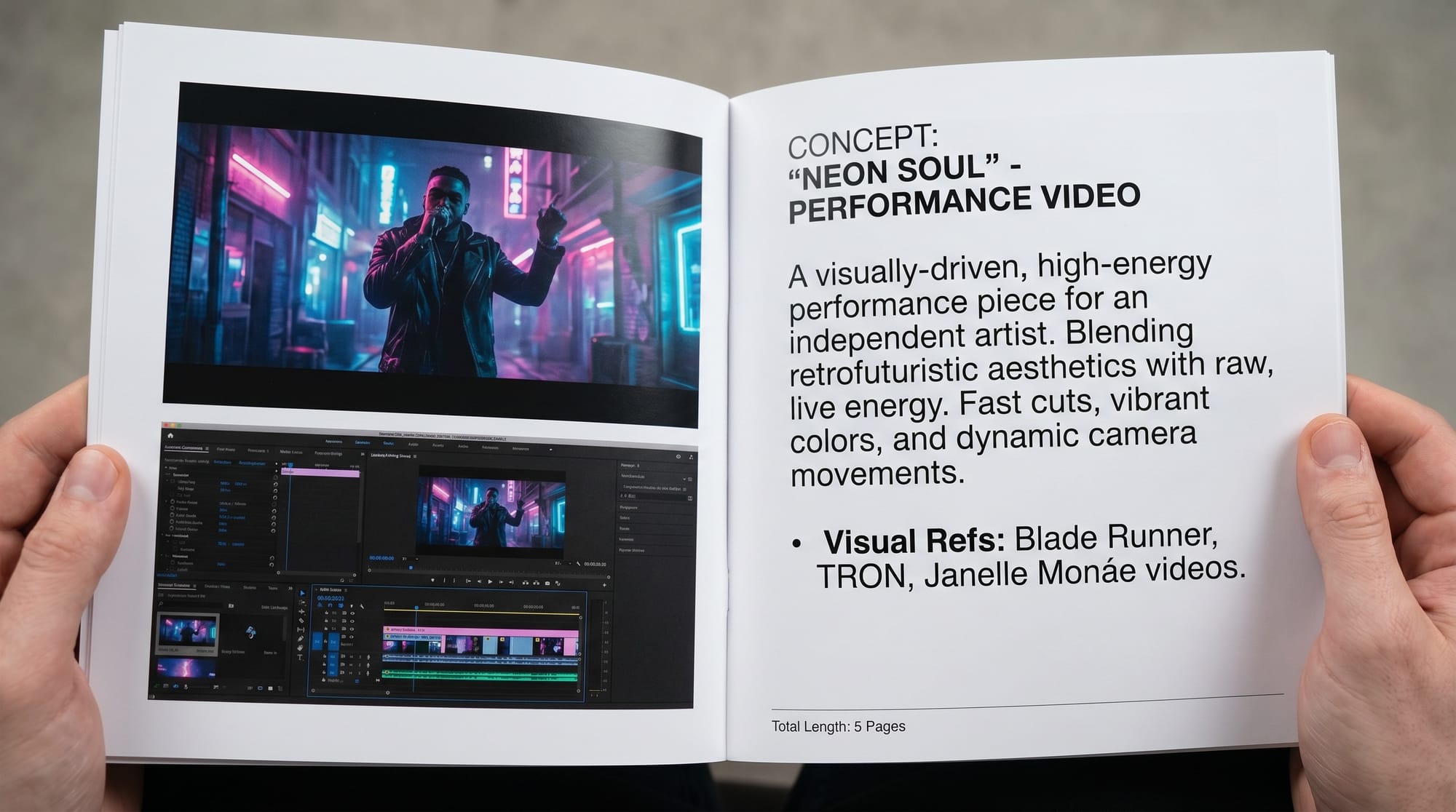
For a narrative video or a label pitch with a proper video commissioner: 8–12 pages, more scene detail, a clear visual approach section, reference images that are specifically chosen rather than generic mood-board fillers.
The failure mode is length that doesn't serve the idea. A 20-page treatment full of text requires 20 minutes to absorb. Labels and artists are time-poor. A treatment that communicates the same idea in 6 minutes wins over one that takes 20.
The mistakes that kill otherwise good treatments
Overpromising on budget is the most expensive mistake. Every element in a treatment is an implicit promise. If your treatment shows a 12-person crew, a helicopter shot, and a custom set build, and the budget is £8,000, the label will notice the mismatch. Pitch to what's achievable. If you don't know the budget, pitch something flexible.
Generic reference images signal generic thinking. Pulling stock photos from a "cinematic" Google search tells the reader nothing specific. References should be precise: this specific film, this specific photographer, this specific shade of blue.
No clear concept is the quietest killer. "The artist performs in multiple locations that represent different emotional states" isn't a concept — it's a description of footage. A concept is a specific idea about what the video means and how it creates that meaning visually. One gives the label something to respond to. The other gives them nothing.
Submitting late is the one mistake that's entirely within your control. When a label collects treatments from multiple directors, the first treatment in sets the frame against which all subsequent ones are compared. Per Wrapbook's guide to the treatment process, early submission is one of the most consistently undervalued advantages in treatment pitching. I've sent treatments inside four hours of receiving a brief when the idea was clear from the first listen. Two of those turned into jobs.
When you're writing for yourself, not a label
Most treatment advice is written for directors pitching to labels. If you're a solo creator shooting your own video, you still need a treatment — just a different kind.
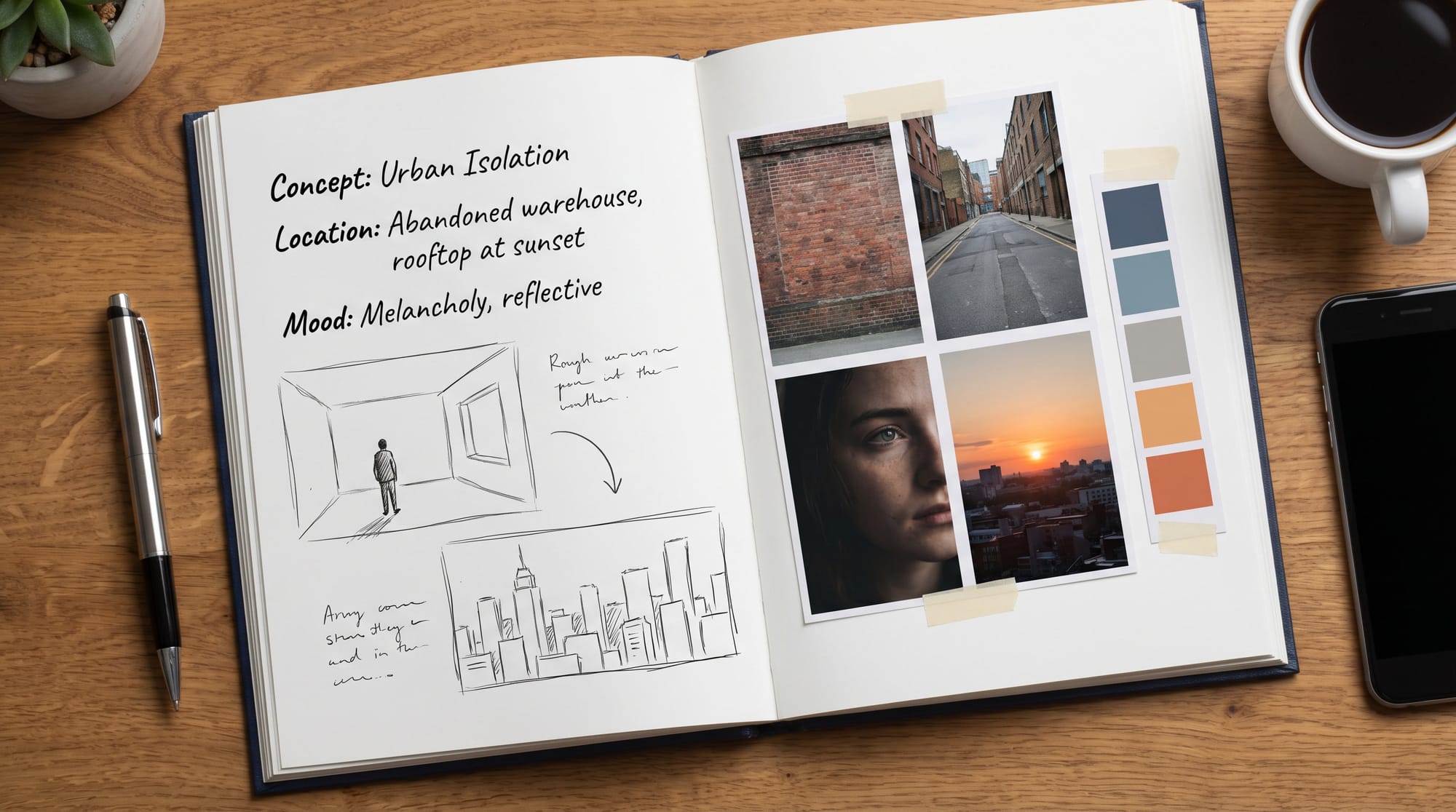
A self-directed treatment is a document you write before the shoot to make decisions in advance. What's the concept? What do the locations look like? What's the colour palette? What's the visual arc across the song? What happens in each section? I wrote a two-page self-treatment for a recent phone shoot — zero budget, just me and the artist — and it cut 45 minutes off the shoot day because every setup decision had already been made on paper.
It doesn't need to be formatted as a pitch document. A Google Doc with images pasted in is fine. What it needs to do is force decisions before you're standing on location wondering what to shoot. For the full no-budget shoot workflow: How to Make a Music Video Without a Budget → Once the treatment is done and you're on set, the next decisions are about camera: Best Camera Settings for Music Videos →
FAQ
How to write a treatment for a video? Listen to the song until you have a specific visual idea. Write a 1–3 sentence concept. Pair it with reference images that show the aesthetic. Add a scene breakdown if the video has a narrative. Total length: whatever communicates the idea completely, usually 4–12 pages.
What does submit a treatment for a video mean? When a label, artist, or video commissioner puts out a brief, they invite multiple directors to submit their creative vision in treatment form. You submit to pitch your concept and win the directing job. The label reviews all treatments with the artist and management, then selects the director whose vision best serves the song.
How should a treatment be written? In present tense, visually. "The artist moves through an empty building" — not "will move" or "I envision moving." Treatments describe what you see as if it's already happening. Short sentences. Concrete images. Cut anything that's hard to picture.
Where can I find a music video treatment template for free? Wrapbook offers a free downloadable treatment template that covers standard sections as a starting point. Canva has basic treatment layouts if you need design flexibility. Both require adapting — a generic template that looks identical to everyone else's treatment is a disadvantage, not a shortcut.
How long is a music video treatment? 4–6 pages for performance video pitches to independent artists. 8–12 pages for narrative video pitches to labels. Longer isn't better — the goal is the minimum length that communicates the concept completely.
Do you need a treatment to make a music video? Not technically. But any shoot without one is a shoot where decisions happen on the day rather than in advance. Those decisions cost time. Writing even a rough treatment forces choices that would otherwise slow you down when the camera is already rolling. More on pre-production planning: How to Shoot a Music Video Alone (No Crew) →
How do I write a music video treatment with no experience? Start with one specific image the song suggests. Write that image in one sentence. Then ask: what does this look like for the entire video — locations, colour, what happens in the chorus versus the verse? Build outward from the one image. For reference on what a detailed written treatment looks like executed against the final video, StudioBinder's breakdown of Emil Nava's treatment for Eminem's "River" is the most instructive public example available.