YouTube Shorts vs TikTok vs Reels: Where Should You Post in 2026?
Three platforms. Same short-form vertical video. Completely different results.
TikTok was built to get strangers to watch you. Instagram was built to keep people who already follow you engaged. YouTube was built to make content findable for months after you post it.
Three different jobs. The numbers from Q1 2026 make that distinction clearer than ever.
Where each platform stands right now
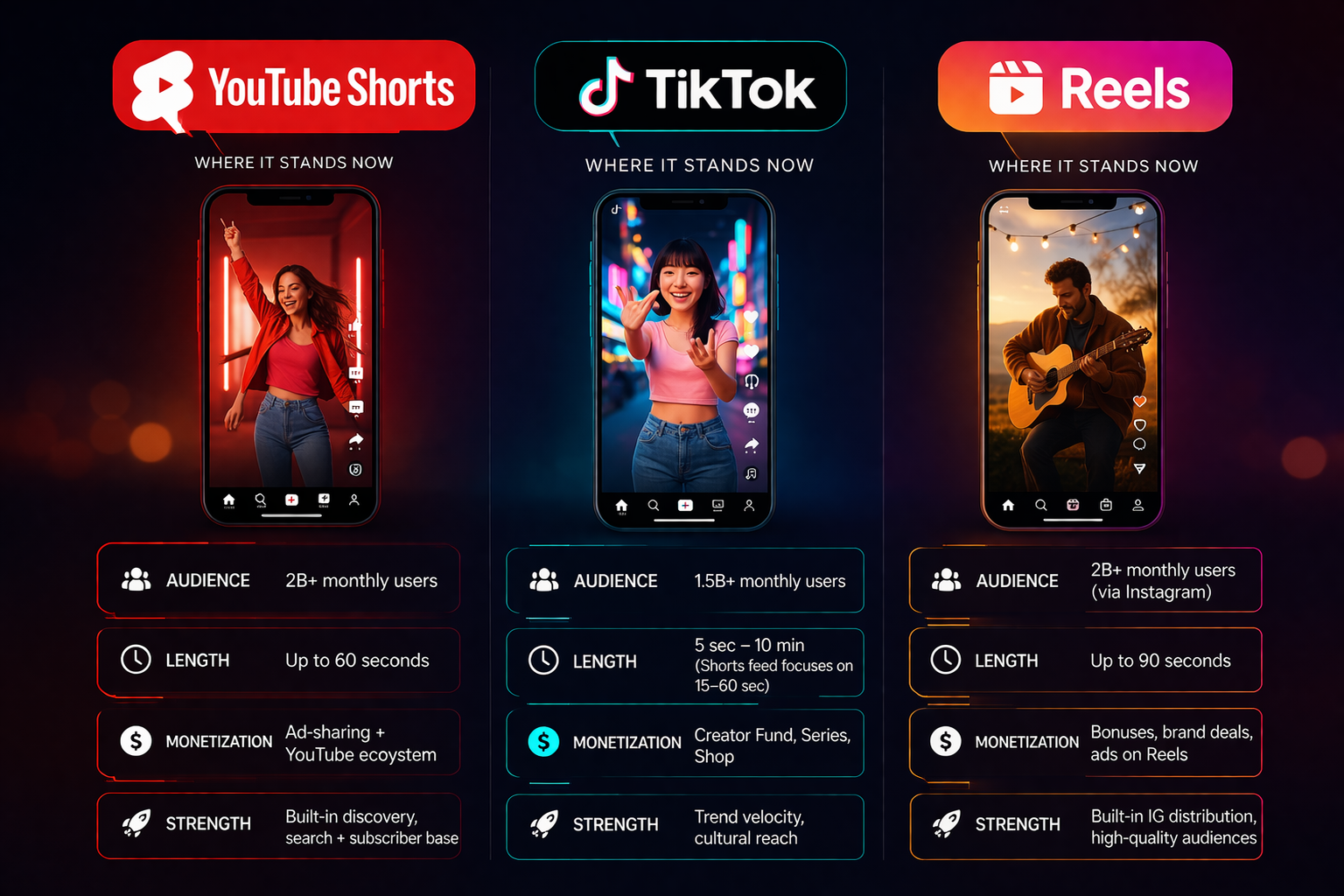
YouTube Shorts generates 200 billion daily views — up from 70 billion in March 2024, a 186% jump in under two years. Monthly users: 2 billion, ahead of both TikTok and Instagram Reels. Seventy-four percent of those views come from non-subscribers, making Shorts YouTube's main organic reach engine. Maximum video length expanded to 3 minutes in 2025, which opened up formats that simply didn't fit when the limit was 60 seconds.
TikTok sits at roughly 1.9 billion monthly active users globally. Users spend an average of 95 minutes per day on the app — more than any other platform. TikTok Shop crossed $15.8 billion in US sales in 2025, up 108% year-over-year, and is projected to exceed $20 billion in 2026. On the ownership situation: TikTok transferred to US ownership (TikTok USDS LLC, involving Oracle and Silver Lake) in January 2026. Full deal terms are still not public.
Instagram Reels commands a 30.81% average reach rate — more than double what carousels or static posts achieve on the same account. Reels now account for 46% of all time spent on Instagram in the US and are reshared 4.5 billion times daily through DMs. That sharing number matters because it's the signal the algorithm weights most heavily.
The engagement numbers — and why they don't compare directly
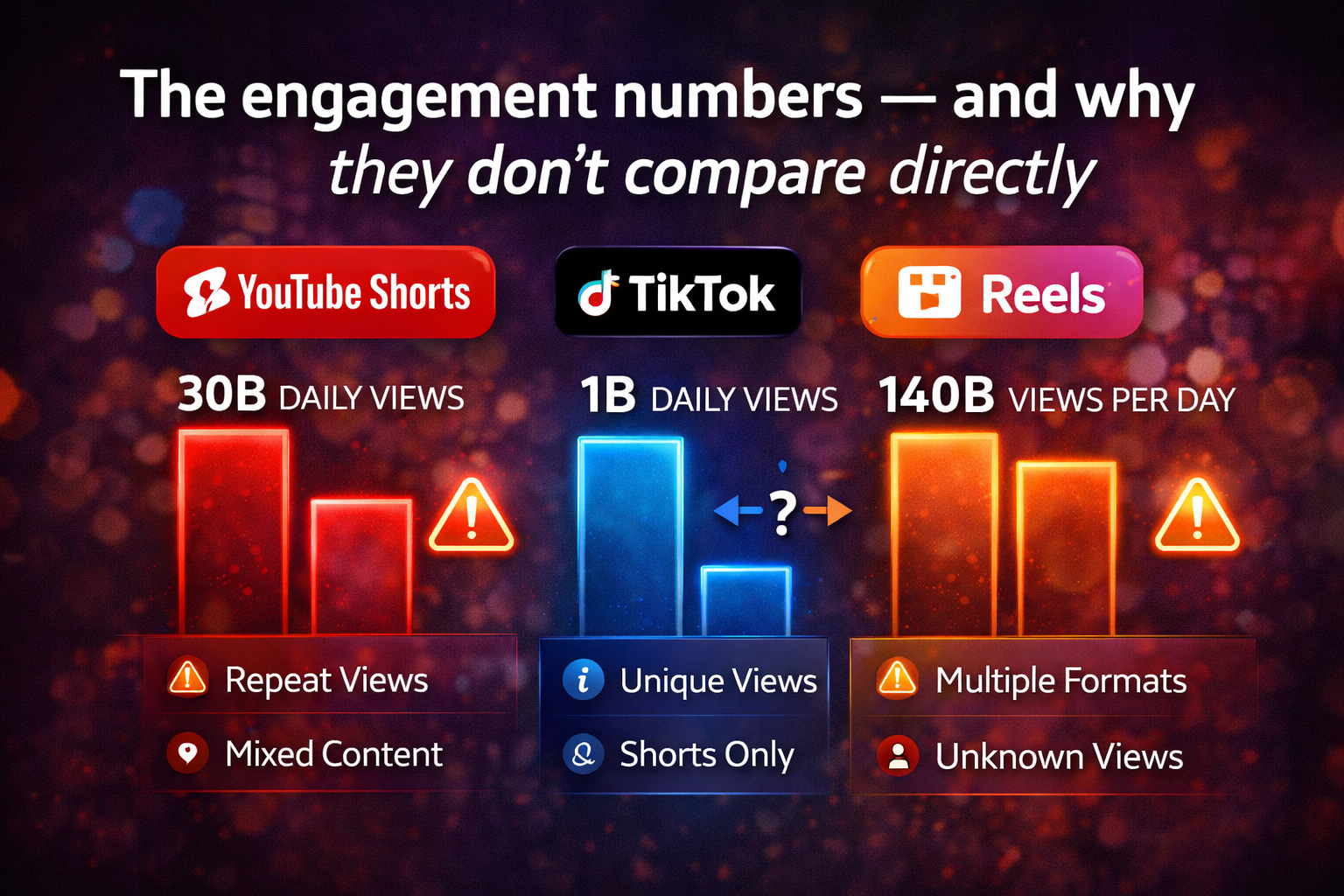
YouTube Shorts leads with a 5.91% average engagement rate (Q1 2026, Socialinsider). TikTok sits at around 4.56%. Instagram Reels at roughly 1.23% per post.
Before anyone concludes Reels is failing: these numbers measure different things on different bases. YouTube measures engagement as a percentage of total views — likes, comments, shares against how many times the video was actually seen. TikTok has shifted its measurement methodology, and business accounts typically see median rates closer to 3.70% when calculated view-based. Instagram measures engagement relative to follower count, not reach — which produces smaller-looking percentages but against a different denominator entirely.
What matters for a creator making short-form video content: YouTube's 5.91% against 200 billion daily views is a completely different universe of absolute numbers than Instagram's 1.23% against a smaller base. The percentage tells you how content performs relative to exposure. It doesn't tell you how much exposure you'll get.
How the algorithm actually distributes content on each platform
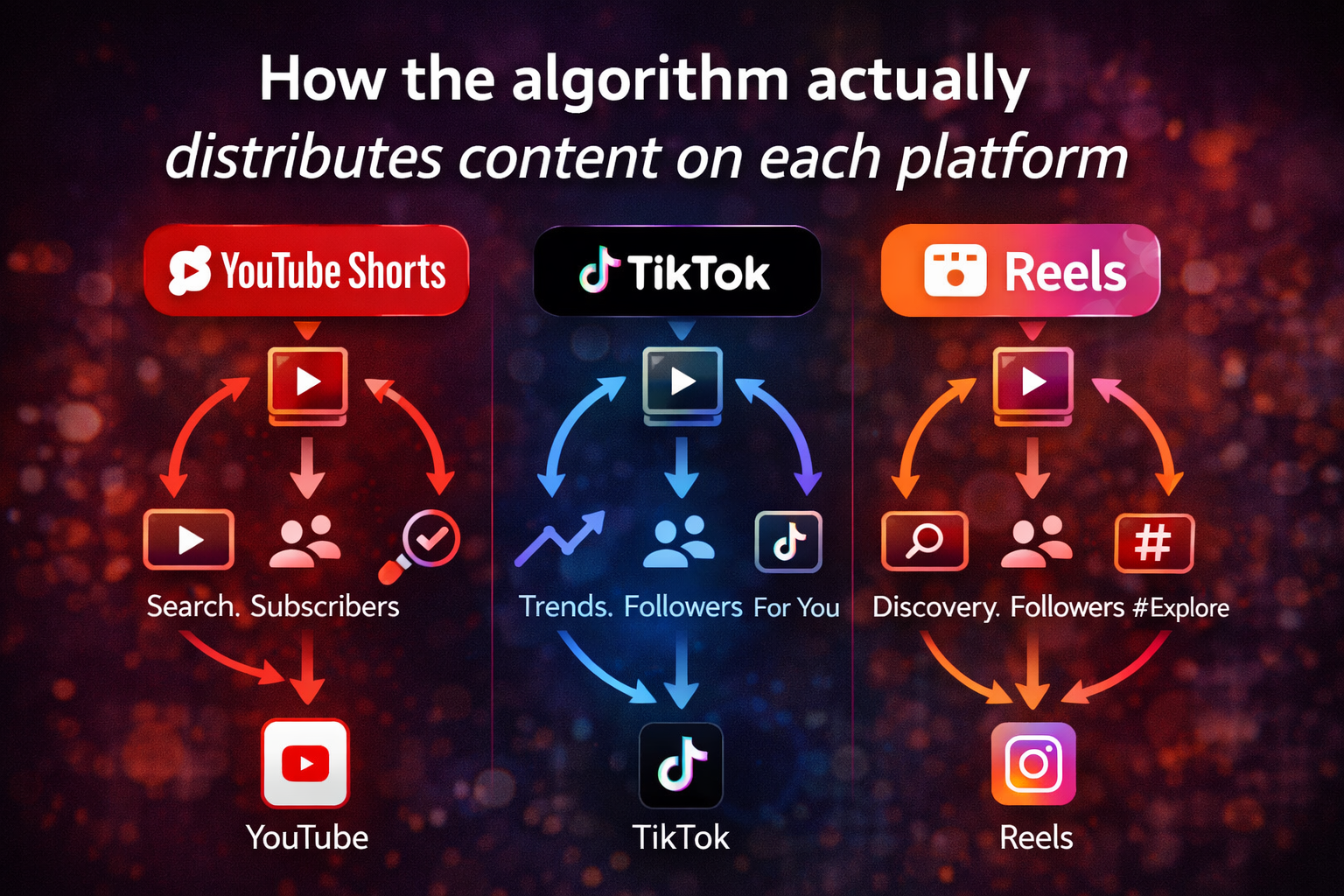
TikTok — and specifically the For You Page, the FYP — distributes based almost entirely on content performance, not follower count. Every video gets tested with a small batch of users whose interests match the content's signals: audio used, text on screen, visual content type. If that batch watches and engages, the video goes to a progressively larger audience. A zero-follower account can reach a million people on a single video if the content performs in those first waves. An established account with ten thousand followers can post something that reaches two hundred people if it doesn't.
The first hour after posting matters more on TikTok than anywhere else. Watch time and completion rate in that window are the signals that trigger broader distribution. Posting when your existing audience is awake — and getting those early views — has an outsized effect on organic reach.
YouTube Shorts runs a two-phase system. Phase one: the video goes to a small test audience based on topic relevance, channel signals, and viewer history. Phase two: if watch time and swipe-away rate clear thresholds, distribution expands. Channel authority matters in a way it doesn't on TikTok — an established channel gets a bigger initial test audience than a brand new one, which makes Shorts harder to break into cold but more predictable once you have a track record.
The structural advantage is search. Shorts appear in YouTube and Google search results. A Short about color grading posted in November can be found in March by someone searching for that technique. TikTok content typically peaks within 24–48 hours and then it's done. A Short compounds over months. For content creators building long-term niche content, this difference is significant.
Instagram Reels starts by showing content to a subset of existing followers. If that group engages, distribution expands through the Reels tab and Explore. DM shares — when someone sends a Reel to a specific person — are the signal Instagram weights most heavily. Content worth recommending to a friend gets amplified more than content that gets passive likes from strangers.
For creators building from zero: Instagram is the slowest of the three for cold discovery. For creators with an established following: it's the most reliable format on the platform for reaching people who already know you.
Posting frequency matters differently on each platform
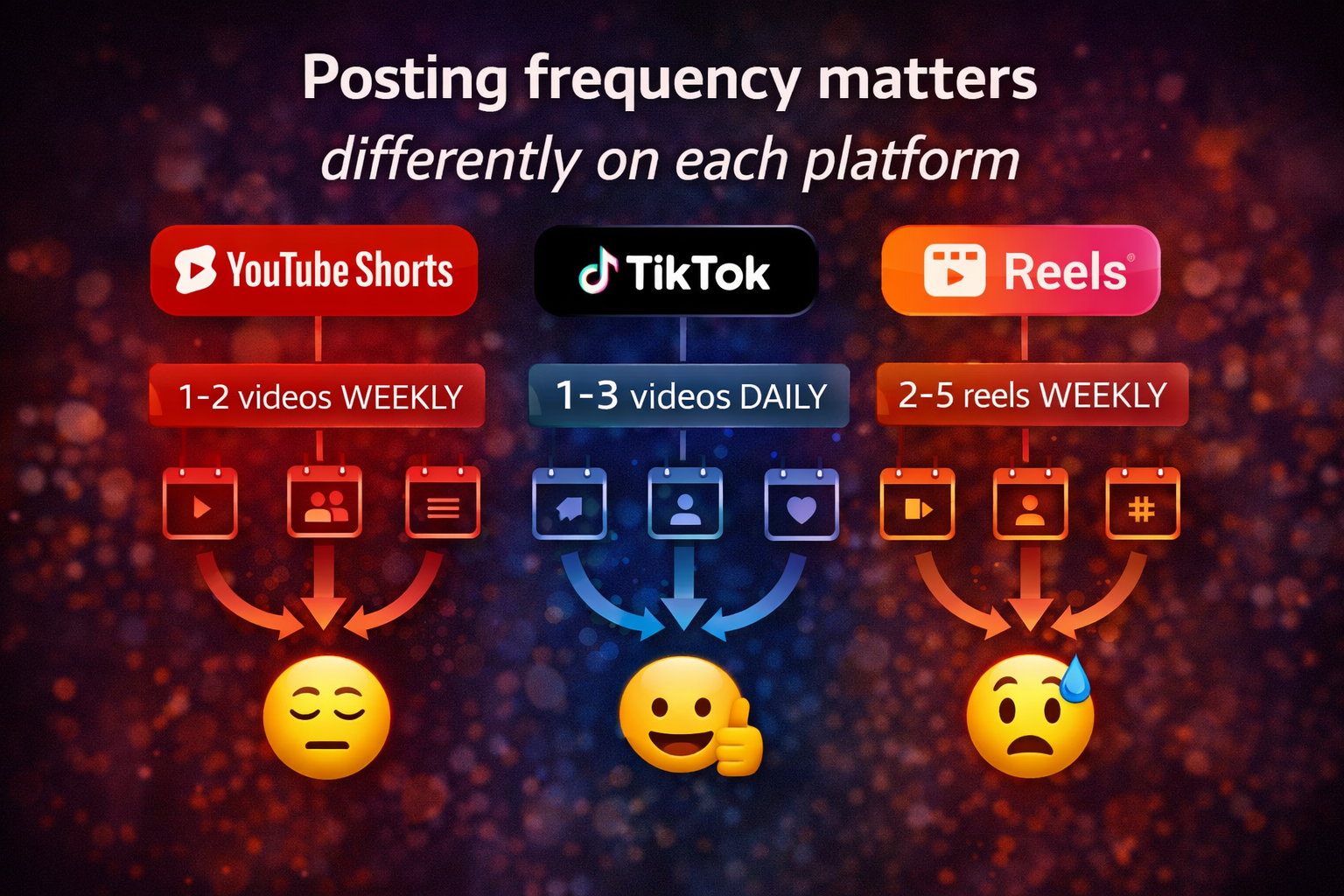
This is one of the most searched questions in this topic and most comparison articles skip it entirely.
TikTok rewards volume — 5 to 7 short-form videos per week gives the algorithm enough data points to understand your content and build momentum. Posting once a week on TikTok is like whispering in a crowded room.
YouTube Shorts works well at 3 to 5 per week, ideally paired with regular long-form uploads on the same channel. The combination — Shorts for discovery, long-form for depth — is what drives subscriber growth: channels using both formats grow 41% faster than those using only one.
Instagram Reels can sustain quality over quantity. Three to four Reels per week is enough to stay in the algorithm's field of view without burning through your content or your audience's patience.
What each platform actually pays
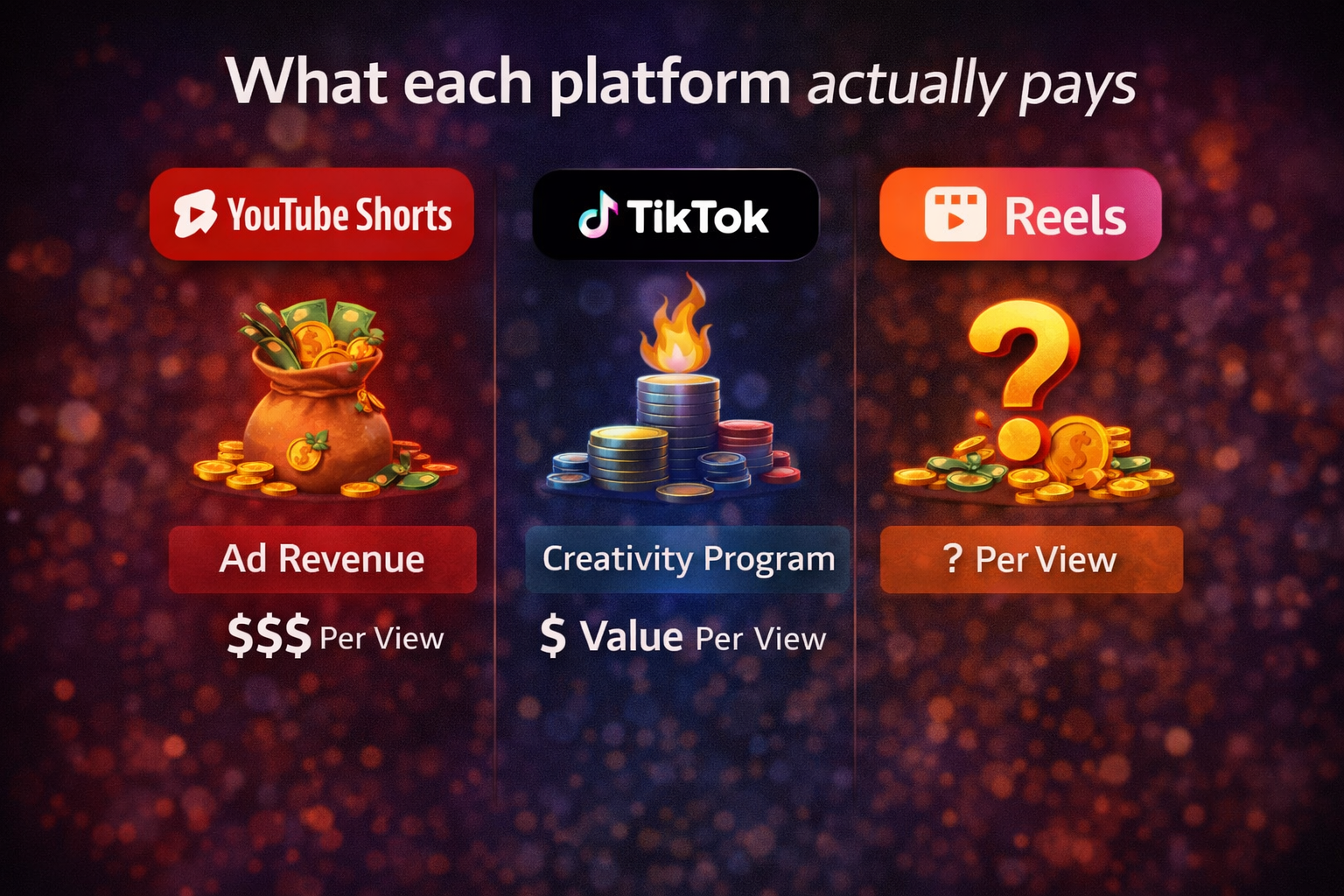
YouTube Shorts shares 45% of ad revenue from the Shorts feed with creators. Requirements: 1,000 subscribers plus 10 million Shorts views in 90 days. The RPM on Shorts itself is low — $0.01 to $0.07 per thousand views, meaning millions of views before meaningful ad income. The real monetization is what Shorts do to the channel ecosystem: they funnel viewers to long-form content where CPMs reach $5–20+, and from there into memberships, affiliate links, and merchandise.
TikTok's Creator Rewards Program pays $0.40–$1.00 per thousand views, but only on videos over one minute with strong originality scores. Most short clips don't qualify. The actual money in TikTok's creator economy in 2026 is TikTok Shop — $15.8 billion in US sales in 2025 and growing. For anyone selling or promoting products, TikTok's commerce infrastructure is the most developed of the three platforms.
Instagram Reels has no ad revenue share equivalent to YouTube's program. Income comes from brand partnerships, invite-only bonus programs paying $100–35,000 per month depending on engagement, and Instagram Shopping integration. Conversion rates from Reels are roughly 55% higher than static posts for accounts with Shopping enabled. It remains the most mature influencer marketplace of the three — more brand deal infrastructure, and proportionally more competition for it.
Who each platform actually reaches
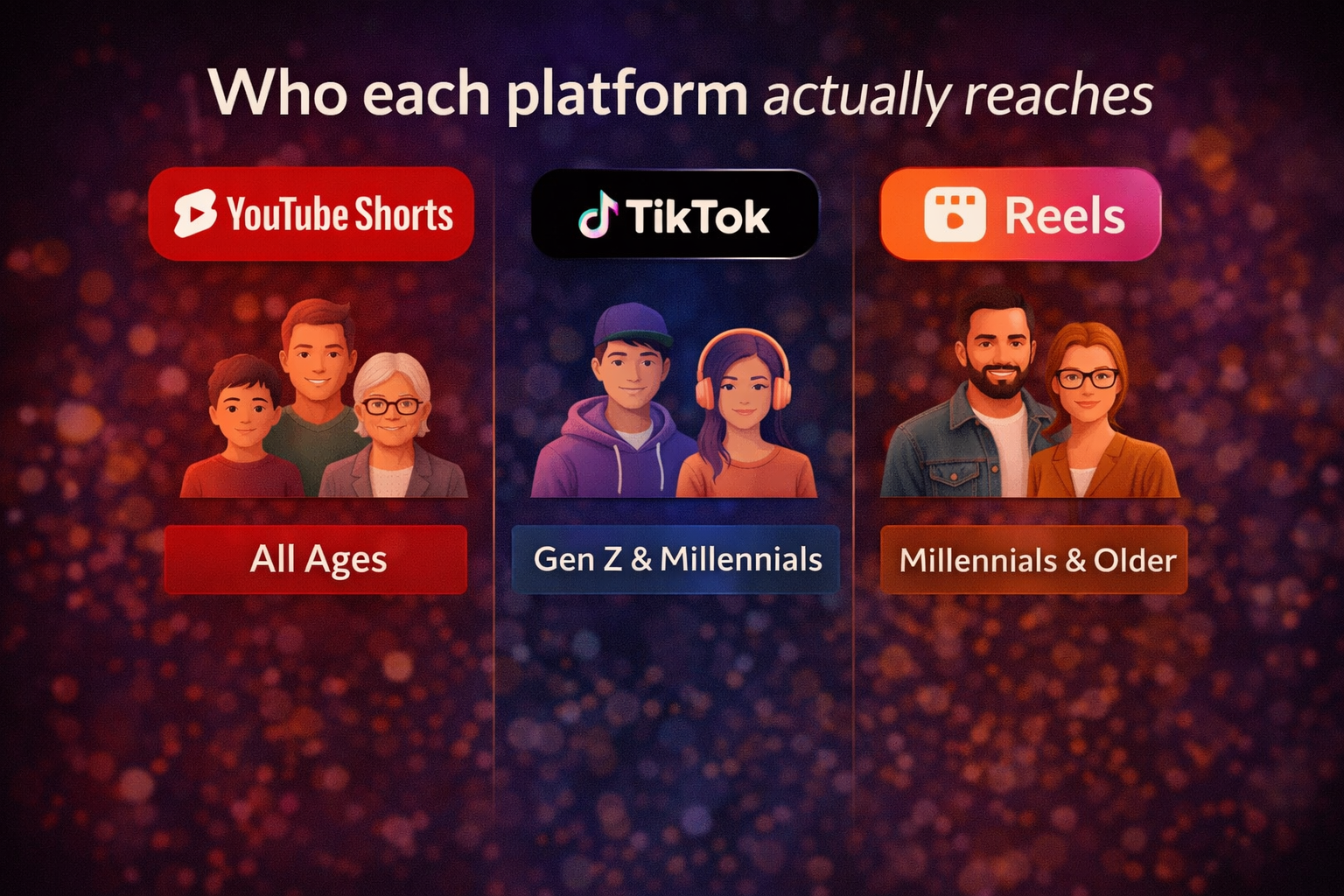
TikTok skews 18–34 and is where Gen Z and younger millennials spend the most social media time. It's where trends, sounds, and formats originate in the creator economy before migrating to other platforms a week later. The US regulatory situation is real — the app was briefly offline in January 2025, came back under new ownership, but the risk of disruption is no longer theoretical. Building an audience solely on TikTok carries platform dependency risk that YouTube or Instagram don't.
YouTube Shorts has the broadest demographic range — strong reach from 18–49. The core US Shorts viewer is 25–34, college-educated, slightly male-skewing. But search changes this: a Short about a specific technique reaches whoever searches for it, regardless of demographic profile. Seventy-five percent of Shorts views come from outside the creator's own country, which matters for niche content with global interest.
Instagram Reels indexes strongly on 18–44, with heavy millennial concentration. Visual industries — fashion, food, travel, fitness — have the most established creator ecosystems here. It's also the most mature platform for brand partnerships, which matters once sponsored content becomes part of how you earn.
For music video creators specifically
TikTok is where audio travels. Sounds and music trends originate on TikTok and reshape what audiences expect everywhere else. A clip from a music video that connects with a trending sound, or creates one, can spread in ways that have nothing to do with follower count. The viral reach ceiling for a single piece of content is higher on TikTok than anywhere else.
YouTube Shorts is where content lives. Tutorial-adjacent content — how a shot was achieved, how a grade was built, how a specific effect was created — keeps getting found through search long after it's posted. The 3-minute limit now fits actual music video excerpts rather than just fragments. For building a channel that compounds, YouTube has the structural advantage.
Instagram Reels is where visual identity lands. An existing audience, a consistent aesthetic, a body of work — Reels keeps that audience engaged and occasionally brings new people in through Explore and DMs. It's not the fastest cold-growth engine, but it's the most stable for maintaining a community around a visual style.
The practical answer
Starting from zero: TikTok first. The algorithm and the FYP are the most generous to new accounts of any platform. You'll get faster feedback on what resonates than anywhere else.
Building long-term: YouTube Shorts. Content compounds through search, subscribers stay yours if the platform changes, and the YouTube ecosystem gives you more monetization paths than TikTok or Instagram alone.
Existing Instagram following: Reels are the highest-reach format on the platform. Not instead of the others — alongside them.
On cross-posting: all three platforms detect watermarks from competitors and reduce distribution on watermarked reposts. Export a clean version for each. Beyond that, the hook style, caption format, and audio approach that works on TikTok is different from what works on YouTube or Instagram. The same clip adapted for each platform consistently outperforms the same file uploaded three times.
FAQ
Which platform grows a new account fastest in 2026? TikTok. The For You Page algorithm has the least dependency on existing follower count. A single video can reach hundreds of thousands of people before you have any subscribers.
Which is best for long-term audience building? YouTube. Subscribers stay yours, content surfaces through search for months, and the channel ecosystem is more diverse for monetization than either TikTok or Instagram.
Should I actually worry about TikTok's US situation? Worth having a YouTube or Instagram presence that can absorb your audience if something changes. The January 2025 shutdown proved the risk is real, not hypothetical.
Does posting everywhere hurt performance on individual platforms? Only if you're uploading TikTok-watermarked files to other platforms. Clean exports per platform, and the algorithm doesn't penalise you for existing elsewhere.
Which platform is best for music video content specifically? TikTok for cultural reach and viral discovery. YouTube Shorts for content that compounds over time through search. Instagram Reels for maintaining a visual brand with an existing audience.